Architecture
Overview of SDN Launch Control architecture and system design. If you have questions about the system or particular terms used below, please see the Wiki / FAQ page.
System Overview
SDN Launch Control is a monorepo containing:
- Backend: Django REST API with WebSocket support
- Frontend: Next.js React application
- Database: PostgreSQL with TimescaleDB
- Message Broker: Redis for Celery and WebSockets
Network Diagram
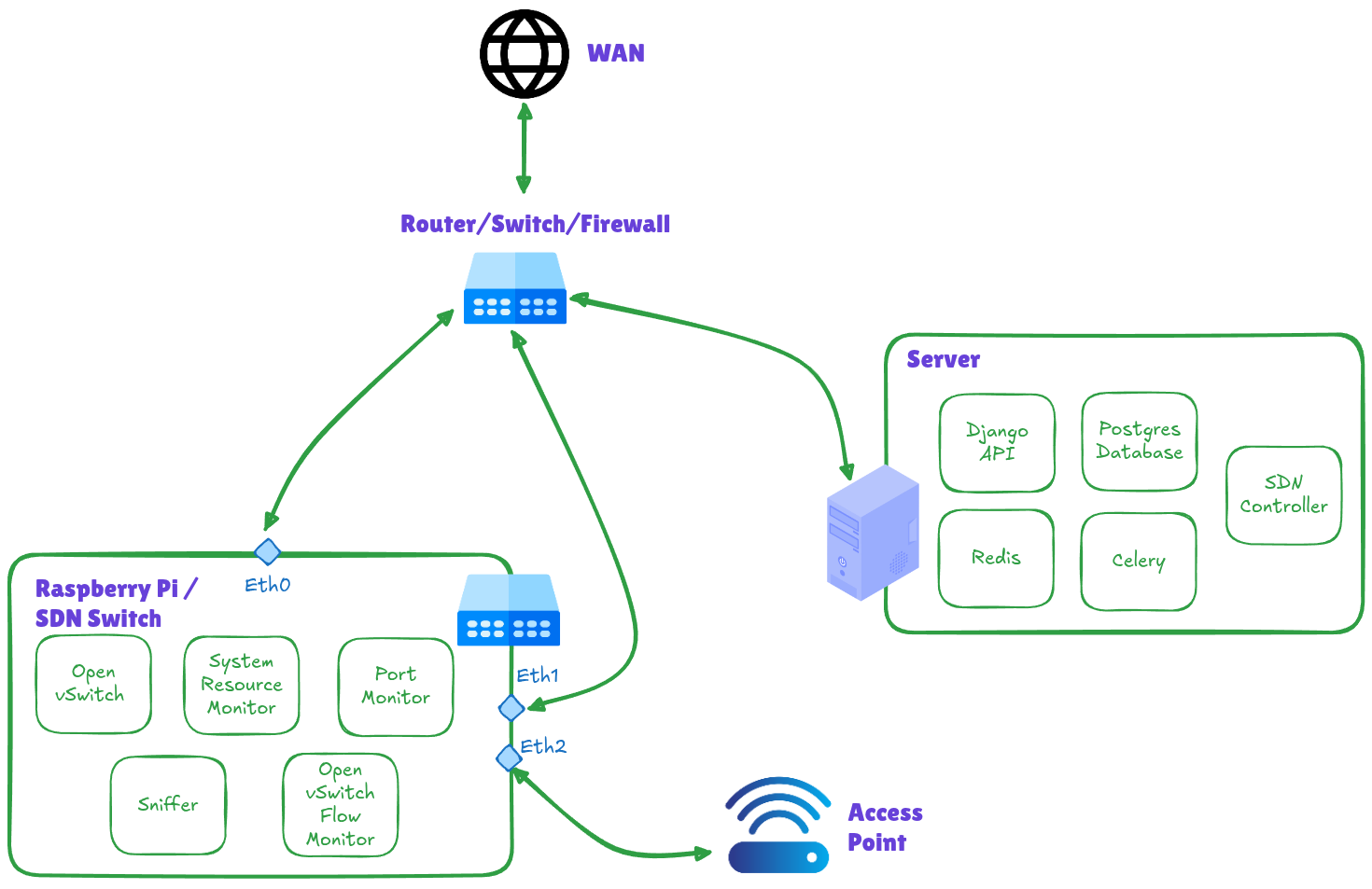
The following example network highlights the services running on each device. The network below is equivalent to the network configured in the basic examples.
The Server
The server runs the backend and frontend code, as well as the SDN controller in most cases. These applications are run in Docker containers: see the backend one here, frontend one here, and the controller here.
The server needs to be able to connect to the switches, so it must be on the same LAN.
The Switch
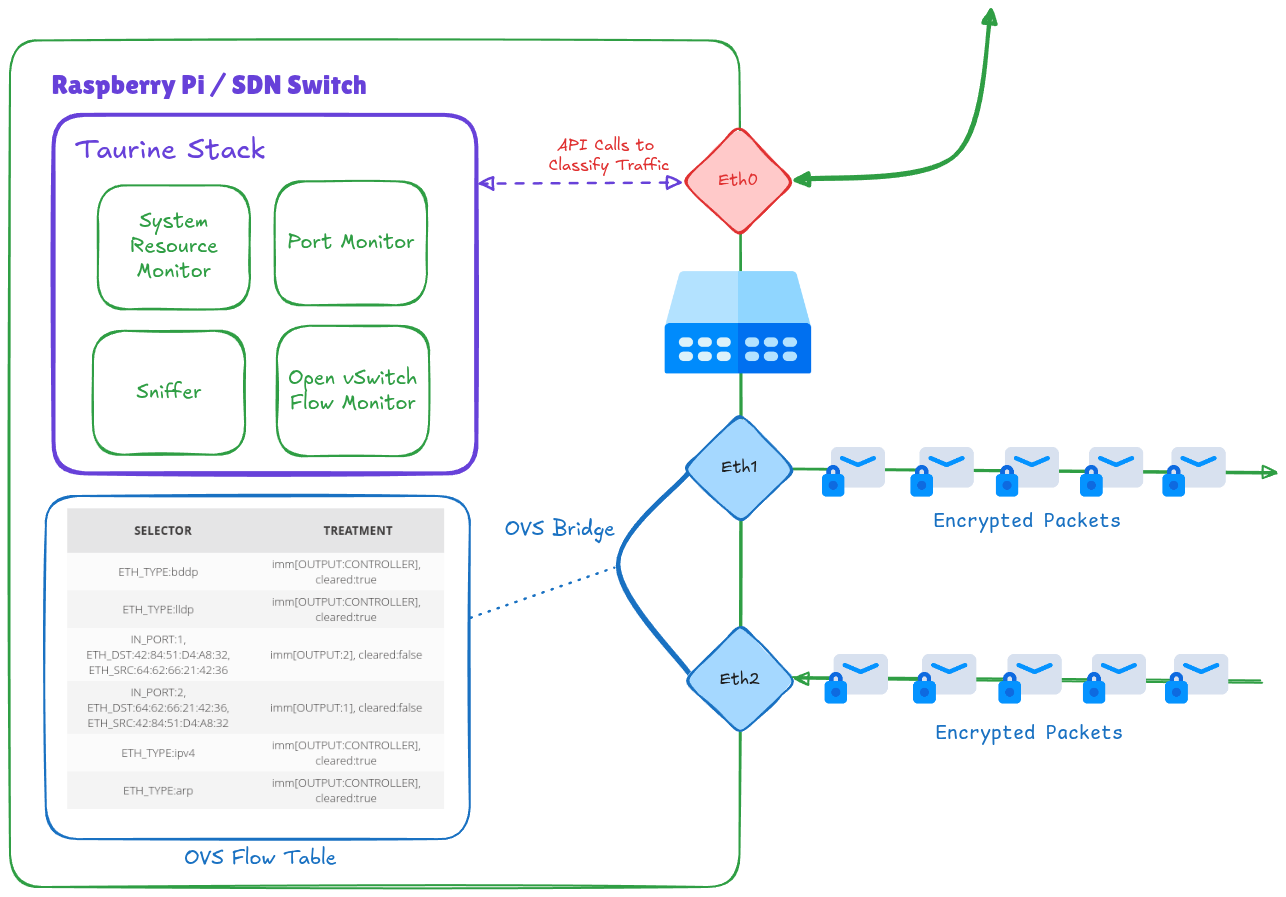
In our examples, we have used a Raspberry Pi with Ethernet adapters as our SDN switch; however, you could have just as easily used any Ubuntu device running an x86 CPU. The Taurine Stack is a collection of tools that enable smart network management.
System Resource Monitor
This collects system resource statistics and sends them to the backend for historical and real-time monitoring.
Port Monitor
This monitors the ports associated with a switch's bridge and sends throughput data to the backend for historical and real-time monitoring.
Sniffer
The traffic sniffer, enabled in the plugin settings, collects packet data on a per-flow level and sends it to the backend. This tool extracts packet payload data for traffic classification.
Open vSwitch Flow Monitor
This tool collects data such as the number of bytes processed by a flow table entry. This data is sent to the backend and linked to classification data to monitor the amount of data used per application.